A Hollywood dawn
When I picture the earliest days of Los Angeles film lots, I see a young woman stepping onto sunlit sets with a mix of nerves and grit. Muriel Virginia Montrose had the kind of presence that belongs to the silent era, a face ready for luminous closeups and a body trained for sudden pratfalls. Before her name shifted to Muriel Dow, before the world met her son Tony on prime time, she carved a small but vivid path through the bustling corridors of studio comedy. Hers is not the tale of a marquee idol but of a practitioner, someone who strapped on courage and swam along with the celluloid tide.
Early years and the Bathing Beauties
Muriel was born in Denver in 1906, then raised within the growing sprawl of Southern California. By her teens she was orbiting Hollywood’s lively ecosystem where casting agents scanned crowds for performers willing to be funny, glamorous, and occasionally fearless. That was the world of Mack Sennett productions, where the famous Bathing Beauties splashed through slapstick sequences and grinned at chaos. Muriel joined those ranks as a bathing beauty, a chorus of sun glitter and comedic timing. Alongside that, she worked as a stunt hand, not the kind with headline billing, the kind you notice only if you know what it takes to leap, skid, and rise with dignity.
The lore around Muriel includes an oft repeated claim that she doubled for Clara Bow. Whether the day’s call sheet credited her or not, the image is irresistible. A spry young woman, hair pinned and wardrobe matched, ready to take a tumble on behalf of a blazing star. The silent era needed people like Muriel, agile and game, able to be both ornament and engine.
Risk and craft in the silent era
Stunt performance in that time looked innocent on screen, frothy and light, yet behind the lens it was all timing and pain management. Muriel showed up in shorts and comedies that demanded those skills. She appears associated with Heart Trouble from 1925, Soldier Man and Hubby’s Little Game in 1926, and The Jolly Jilter in 1927. Credits blur in that period, faces flicker past and names vanish but the work remains. If you study the tempo of those films, you feel the pulse of performers like Muriel. Quick entrances, quicker reactions, the physical intelligence to make accidents look graceful.
She was not pushing toward stardom so much as sustaining the production line that made stardom possible. I like that about her story. It honors the everyday heroics that keep a set moving and a gag landing.
Marriages and the Dow household
Life off set moved at its own pace. In 1927 Muriel married Ray L. Ramsey, a union described as brief. By 1930 she married John Stevens Dow Jr., a designer and general contractor, and the marriage took root. That is the family name that followed her for the rest of her life, Dow, sturdy and domestic, less glamorous than studio marquees yet just as meaningful. The couple built a household that mixed creativity with craft. You can imagine the blend of shop talk and supper, sketches and schedules, and the occasional story about a bruised elbow on a faraway soundstage.
Parents and siblings
Muriel’s roots track to James Fay Montrose Sr. and Alice, frequently listed as Alice Lee Anders or Alice Lee Montrose. The family structure looks like many early twentieth century trees, a father chasing work, a mother keeping home life intact, and a daughter drawn to the new possibilities of moving pictures. Muriel had a younger brother, James Fay Montrose Jr., born around 1910. The Montrose family story is scattered across records and recollections, yet the outlines are steady. Work, migration, and ambition were the rhythms of that era. Muriel wrote her own verse on top of them.
Sons Dion and Tony
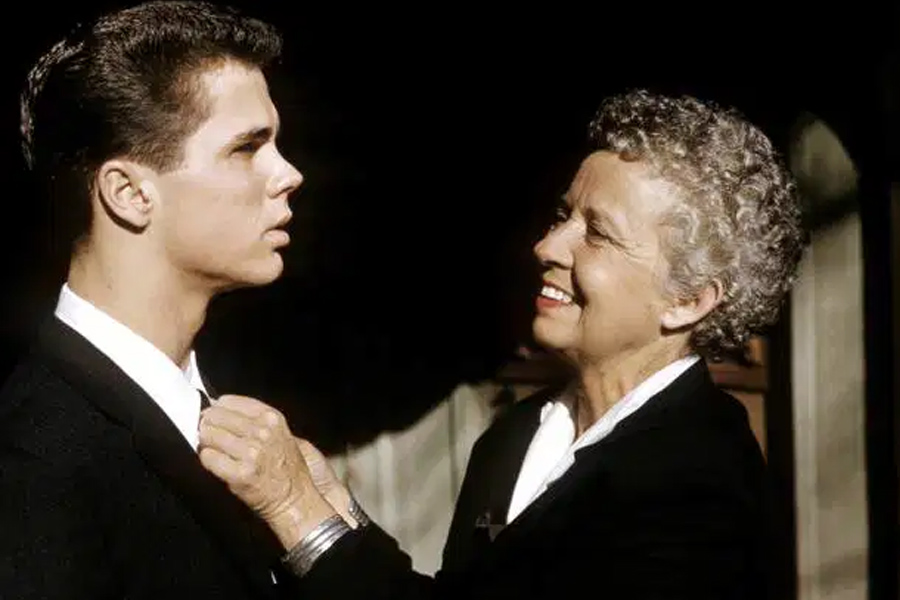
Two sons defined the next act. Dion arrived first, around the early 1930s. His life is remembered through family notes that describe him as studious and thoughtful, a psychology student at UCLA. Then came Tony, born in 1945, recognizable forever as Wally Cleaver. If you grew up on Leave It to Beaver, you know the warmth Tony brought to that role, the older brother with a calm center and quick smile. Muriel did not simply watch that career she helped steer it, serving as an early manager, guiding a teenager through the swirl of publicity and production. It is not hard to imagine how a mother who once navigated sets and gags would understand call times and camera angles, stage moms are many, yet Muriel had an insider’s grasp of the business and a sturdy view of what mattered.
Grandson Christopher
The family line extends to Christopher, Tony’s son, born around the early 1970s. He stepped into the public eye at key moments, reminding us that behind television legends you find grandparents and memories, holiday tables, and the quiet stories that pass down through generations. Christopher’s presence shows how family threads link eras. Muriel’s silent film days and Tony’s network television years are not separate chapters. They are one continuous line, with Christopher in the next scene.
Later years and gentle legends
The portrait of Muriel in later life includes tender domestic details. Remembrances describe wreath making, a knack for arrangement, a neighborly habit of sharing cookies. Even if the stories have the soft blur of nostalgia, they suit her. A woman who once staged pratfalls could easily stage a perfect welcome, part graceful hostess, part practical artisan. Her life ended in 2001, after nearly a century of change. She crossed from nickelodeon moods to digital memories, a span that feels like watching the ocean absorb a thousand sunsets.
Filmography snapshot
- Heart Trouble, 1925, bit role in a comedic framework
- Soldier Man, 1926, appearance in a silent short
- Hubby’s Little Game, 1926, performance in a domestic comedy format
- The Jolly Jilter, 1927, participation in a slapstick piece
These titles read like stepping stones rather than monuments. They mark presence and craft, the long days and quick takes that build careers, even if the credits are thin.
The texture of a family story
I think of Muriel’s life as braided rope, one strand made of studio work, another of marriage and home, a third of parental guidance. The rope holds. Her father’s name sits at one end, her grandson’s at the other, and in the middle she moves from swim scenes and stunts to phone calls and schedules, from spotlight to porch light. That subtle shift is the human scale of Hollywood. Not everyone needs a marquee. Some people keep the set running and then keep the family running, and that is more than enough to deserve attention.
FAQ
Was Muriel Montrose really a Mack Sennett Bathing Beauty?
Yes. She joined the cohort known as the Bathing Beauties, women cast in comedic ensembles that spiced up Sennett productions. The role mixed glamour with playful physicality, a perfect fit for someone comfortable with stunts and timing.
Did she work as a stunt double for Clara Bow?
That claim appears widely and sits comfortably within her profile as a stunt performer and stand in. It suits her skill set. While individual day sheets are not widely available, the connection persists in film history circles and family accounts.
What films or shorts did she appear in during the silent era?
Her work is associated with a cluster of mid 1920s titles, including Heart Trouble from 1925, Soldier Man and Hubby’s Little Game from 1926, and The Jolly Jilter from 1927. Credits were often informal for chorus players and stunt workers, yet her presence around those productions is part of her recognized record.
Who were her parents and did she have siblings?
Her father is listed as James Fay Montrose Sr., her mother as Alice, often recorded as Alice Lee Anders or Alice Lee Montrose. She had a younger brother named James Fay Montrose Jr., born around 1910. The family lived out the familiar Westward narrative of early twentieth century America.
Whom did she marry and did she have children?
She married Ray L. Ramsey in 1927, a short marriage, and then married John Stevens Dow Jr. in 1930. With John she built a long partnership and had two sons, Dion and Tony. The home they created became both refuge and launch pad for the next generation.
How is she connected to Tony Dow of Leave It to Beaver?
Muriel is Tony Dow’s mother. She played an active role in his early career, guiding him through the early demands of television work and offering the practical support that only a parent with industry experience can provide.
What about her grandson Christopher?
Christopher is Tony’s son. He appears in public family moments and keeps the line of memory visible, connecting Muriel’s silent film years to Tony’s television legacy and then to modern audiences who revisit these histories.
When was Muriel Montrose born and when did she pass away?
She was born in May of 1906, commonly cited as May 27, in Denver. She died in 2001. These dates bracket a life that reaches from the silent era to the edge of our contemporary moment, a remarkable span by any measure.
Did she receive major awards or have a large public net worth?
No major awards are attached to her name and reliable net worth figures are not available. Her impact sits in the work itself and in the influence she carried into her family’s creative lives.