The Early Life of Ahamefule J Oluo
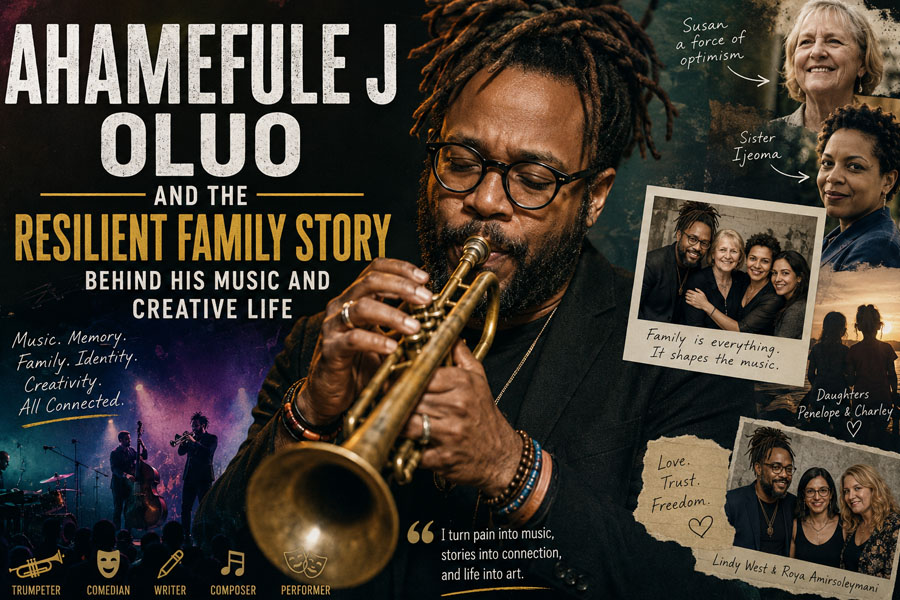
When I look at the life of Ahamefule J. Oluo, I see a story shaped by music, family, hardship, identity, and an unusually determined imagination. Born in 1982 in Denton, Texas, Oluo grew into a multidisciplinary artist whose work refuses to stay inside one category. They are a trumpeter, composer, writer, comedian, performer, and creator of theatrical experiences that blend music with memoir and humor.
Oluo uses both they/them and he/him pronouns and is often called Aham. Their unusual first name, Ahamefule, comes from their Nigerian heritage and is commonly interpreted as meaning something close to “let my name not be forgotten.” That meaning carries particular emotional weight because Oluo’s relationship with their Nigerian father became one of the defining absences of their childhood.
Their father, Samuel Lucky Onwuzip Oluo, was a Black Nigerian immigrant from Rivers State. He was also associated with a chiefly title and studied in the United States. Shortly after Oluo’s birth, however, he returned to Nigeria. Oluo never met their father in person.
Their mother, Susan Jane Hawley Oluo, was a white woman from Kansas. After the father’s departure, Susan became the central parent in the household. She raised Oluo and their older sister, Ijeoma, largely on her own while working multiple jobs and navigating severe financial hardship.
The family eventually settled in the Seattle area, where Oluo grew up. Their childhood was far removed from the comfortable image sometimes associated with successful artists. There were periods without electricity or a telephone, and the family sometimes lived in a car. Poverty was not simply a background detail. It became part of the emotional landscape from which Oluo later created art.
| Family detail | Information |
|---|---|
| Full name | Ahamefule J. Oluo |
| Born | 1982 |
| Birthplace | Denton, Texas |
| Mother | Susan Jane Hawley Oluo |
| Father | Samuel Lucky Onwuzip Oluo |
| Sister | Ijeoma Oluo |
| Heritage | Nigerian and white American |
| Primary instrument | Trumpet |
| Current region | Rural Washington |
| Major artistic fields | Music, theater, writing, comedy, performance |
Susan Oluo and the Mother Who Became Part of the Art
Susan Jane Hawley Oluo occupies an important place in the story because she was not simply the parent who raised the children. She became an artistic subject in her own right.
Oluo has described their mother as extraordinarily optimistic, even while dealing with circumstances that could have crushed that optimism. She worked multiple jobs, raised two children without the daily presence of their father, and dealt with the practical difficulties of poverty. Yet her personality remained warm and hopeful.
That contrast became the foundation of Susan, one of Oluo’s major performance works.
In that piece, the mother becomes more than a character from childhood memories. She becomes a symbol of endurance. I find that aspect particularly revealing because Oluo does not present family history as a collection of dates and names. Instead, memories become music, jokes, physical movement, and stories.
Susan’s influence also helps explain why humor is so important in Oluo’s work. Their family story contains painful subjects, including abandonment, financial insecurity, illness, and complicated identity. Humor provides a way to approach those subjects without reducing them to tragedy.
Ijeoma Oluo and a Shared Family History
Oluo’s older sister, Ijeoma Oluo, was born in 1980 and became a prominent writer and activist. The siblings share the same parents and grew up experiencing many of the same family circumstances.
Ijeoma eventually developed her own public voice through writing about race, identity, inequality, and American society. Her work includes the widely known book So You Want to Talk About Race.
The siblings’ careers took different forms, but there is a striking common thread. Both transformed personal experience into public storytelling.
Ijeoma has also appeared as herself in Thin Skin, the film connected to Oluo’s autobiographical performance work. Her presence gives the project an additional layer because the family history is not being remembered by only one person. It becomes a shared family archive, with different members carrying different pieces of the same past.
The Absence of Oluo’s Father
The story of Samuel Oluo is one of the most emotionally significant parts of Ahamefule’s biography.
After returning to Nigeria shortly after his child’s birth, Samuel remained largely absent. Oluo has written and spoken about the complicated feelings surrounding that absence. There was a brief reconnection around 1999, when Oluo was approximately 16 or 17. The family had a phone conversation, but the relationship never developed into a conventional father and child relationship.
Samuel died in 2006.
For Oluo, the absence of a father was not simply an unanswered family question. It became material for artistic exploration. The Nigerian side of their identity existed partly through stories, names, memories, and distant relatives rather than ordinary childhood contact.
That tension between belonging and distance appears repeatedly in Oluo’s creative work. The name Ahamefule itself seems to carry the weight of a lineage that was physically distant but impossible to ignore.
Marriage, Children, and a Blended Family
Oluo has been married three times. Their first marriage ended in 2006, during an especially difficult period of their life.
They have two daughters from that earlier marriage, Penelope and Charley. The daughters have remained part of a broader blended family that includes writer and comedian Lindy West.
Oluo married Lindy West on July 11, 2015. West is known for her writing, comedy, activism, and memoirs, including Shrill: Notes from a Loud Woman. Their relationship has also been part of their artistic lives, with the two collaborating on creative projects.
West became a stepmother to Oluo’s daughters, creating a family structure that is more layered than a conventional household. Rather than hiding those complexities, the family has often discussed the ways relationships can evolve over time.
Around 2019, Oluo also began a relationship with Roya Amirsoleymani, a curator, writer, and creative producer. The three adults eventually became publicly associated with a polyamorous relationship.
Their family life has consequently become part of the larger conversation surrounding Oluo’s work. It is another example of how their personal experiences often become material for storytelling rather than something kept completely separate from their art.
Ahamefule J Oluo and Industrial Revelation
Music became one of Oluo’s strongest languages throughout his life.
They were founding members of Industrial Revelation, a Seattle quartet that included drummer D’Vonne Lewis, bassist Evan Flory-Barnes, keyboardist Josh Rawlings, and trumpeter Oluo. The trio formed in 2005 and established a new sound that defied traditional jazz notions.
I’d describe Industrial Revelation as music with jazz roots and a restless heart.
The band blends improvisation with punk, soul, funk, rock, hip-hop, electronica, and psychedelic music. Lewis’ percussion can make the music feel powerful and nearly explosive, while Oluo’s trumpet alternates between lyrical sections, distortion, effects, and experimental sounds.
The band has also been referred to as “garage jazz” or “everything music.” These descriptions make sense because the quartet does not see genre borders as barriers.
Industrial Revelation received a Stranger Genius Award for Music in 2014. Albums like Oak Head and Liberation & the Kingdom of Nri showcase the group’s extensive musical vocabulary.
Oluo has also played and recorded with Das Racist, John Zorn, Hey Marseilles, Wayne Horvitz, Macklemore, and Julian Priester.
When Illness Changed the Direction of the Music
One of the most difficult chapters in Oluo’s life came around 2006, when they experienced a severe autoimmune reaction involving Stevens-Johnson syndrome and toxic epidermal necrolysis.
The illness caused extensive skin damage and affected the mouth and hands. For a trumpet player, damage in those areas was particularly devastating. Playing the instrument requires precise physical control, and Oluo temporarily could not do what had become central to their artistic identity.
The experience eventually became part of Now I’m Fine.
Rather than treating illness as an isolated medical episode, Oluo transformed it into performance. The resulting work combined trumpet, storytelling, comedy, percussion, looping, and memoir.
That transformation is characteristic of their career. A painful experience becomes a performance. A family memory becomes theater. A difficult relationship becomes a story. Even an instrument temporarily taken away becomes part of the eventual artistic language.
Now I’m Fine and Thin Skin
Now I’m Fine emerged from a turbulent period involving illness, divorce, the death of Oluo’s father, and the complicated process of recovery.
The work was developed during Oluo’s 2012 residency at Town Hall Seattle and eventually received a full production at On the Boards in 2014. It later appeared at the Public Theater’s Under the Radar festival in 2016.
The performance mixed autobiographical storytelling with original music and stand-up comedy. It was neither a conventional concert nor a traditional theater piece. Instead, Oluo created something closer to a musical autobiography.
The work later became Thin Skin, a film released after its theatrical development. Oluo wrote, scored, and starred in the film, with Lindy West and Charles Mudede involved in the writing and Mudede directing.
I see Thin Skin as an extension of the same impulse that shaped Now I’m Fine. The story moves between personal pain and absurdity, allowing laughter to exist beside grief.
Ijeoma Oluo appears in the film, adding another connection between the siblings and the family’s history.
Susan and The Things Around Us
After Now I’m Fine, Oluo continued developing the intersection of theater, music, comedy, and memory.
Susan emerged as a tribute to their mother. The work examines family, optimism, hardship, and the strange ways children remember their parents.
Then came The Things Around Us, which premiered in 2024 as part of the Time-Based Art Festival at the Portland Institute for Contemporary Art.
This solo performance moves in a different direction while retaining Oluo’s characteristic mixture of music and storytelling. Looping technology allows small musical gestures to accumulate into larger textures. Trumpet, clarinet, percussion, effects, spoken language, and everyday objects can become part of the performance.
The work explores connection and patterns, suggesting that apparently ordinary moments can form intricate systems when viewed from another angle.
Its touring life continued through 2025 and 2026, reaching venues and festivals in Seattle, New York, the United Kingdom, Boston, Florida, and other locations.
A Creative Life Built Around Collaboration
Oluo’s career is difficult to summarize with a single job title because they have never operated within only one artistic lane.
They have worked as a composer, musician, comedian, writer, producer, actor, and theater creator. They have contributed to television projects, including Santa Inc., appeared on This American Life, co-produced comedy albums for Hari Kondabolu, and collaborated with West on performance projects.
Their career has also included residencies and grants connected with institutions and organizations such as MacDowell, Yaddo, Creative Capital, Artist Trust, the Mellon Foundation, and the MAP Fund.
The variety is not accidental. Oluo’s art often behaves like a bridge. Music leads into storytelling. Storytelling becomes comedy. Comedy turns into autobiography. Autobiography becomes theater.
Returning to Nigerian Family Roots
The Nigerian side of Oluo’s family history has remained important even though their father was absent for most of their life.
Oluo has had connections with relatives from the Nigerian side of the family, including references to a half-brother named Eze-Basil Chinwendu Oluo D’Oracle. These relationships have helped connect Oluo with a part of their ancestry that was largely inaccessible during childhood.
This gives the name Ahamefule an especially poignant meaning.
A name can be a small vessel carrying an enormous history. For Oluo, it connects a child raised in the Seattle area to a father from Nigeria, to a lineage that existed across an ocean, and to questions about what it means to inherit an identity from someone who was never physically present.
Rural Washington and a Life Outside the Spotlight
Although Oluo is still tied to Seattle’s artistic world, their recent existence has been affiliated with rural Washington and the Olympic Peninsula.
Living in a rural setting is an intriguing contrast to the intensity of their professional work. Their work continues to take them to theaters, festivals, residencies, and performance spaces, while their home life revolves around a more tranquil landscape near Hood Canal and the Coyle peninsula.
That contrast feels appropriate.
Oluo’s work has always alternated between seclusion and performance, grief and laughter, structure and improvisation, family history and personal reinvention.
There are no accurate public figures to determine Oluo’s exact net worth. Their income appears to be derived from a combination of performances, tours, commissions, writing, production work, residencies, grants, and other creative endeavors. Their financial situation differs significantly from that of a mainstream commercial celebrity.
FAQ
Who is Ahamefule J Oluo?
Ahamefule J. Oluo is an American multidisciplinary artist born in 1982 in Denton, Texas. They are primarily known as a trumpeter and composer, but their career also includes writing, stand-up comedy, theater, film, and live performance.
Who are Ahamefule J Oluo’s parents?
Their father was Samuel Lucky Onwuzip Oluo, a Nigerian immigrant from Rivers State. Their mother is Susan Jane Hawley Oluo, a white American woman from Kansas who raised Oluo and their sister largely as a single parent.
Does Ahamefule J Oluo have a famous sibling?
Yes. Their older sister is Ijeoma Oluo, a prominent writer and activist known particularly for her work on race and American society.
Who is Ahamefule J Oluo married to?
Oluo married writer and comedian Lindy West on July 11, 2015. They had begun dating several years earlier and have collaborated artistically.
Does Ahamefule J Oluo have children?
Yes. Oluo has two daughters from a previous marriage, Penelope and Charley. Their family has also included Lindy West as a stepmother.
What happened to Ahamefule J Oluo’s father?
Samuel Oluo returned to Nigeria shortly after Ahamefule’s birth and remained largely absent. There was a brief reconnection by phone around 1999. Samuel died in 2006.
What is Industrial Revelation?
Industrial Revelation is a Seattle instrumental quartet founded in 2005. The group features D’Vonne Lewis, Evan Flory-Barnes, Josh Rawlings, and Ahamefule J. Oluo. Its music blends jazz improvisation with rock, punk, soul, funk, hip-hop, and experimental sounds.
What happened to Ahamefule J Oluo’s health during the period that inspired Now I’m Fine?
Oluo experienced a severe autoimmune reaction involving Stevens-Johnson syndrome and toxic epidermal necrolysis. The illness caused extensive skin problems and temporarily interfered with their ability to play trumpet.
What is The Things Around Us?
The Things Around Us is a solo performance created by Oluo that combines music, looping technology, storytelling, humor, and theatrical performance. It premiered in 2024 and continued touring through 2025 and 2026.
What does the name Ahamefule mean?
Ahamefule is a Nigerian name associated with Igbo language and heritage. It is commonly interpreted as meaning something like “let my name not be forgotten,” connecting the name to family lineage and remembrance.
Where does Ahamefule J Oluo live?
Oluo has been associated in recent years with rural Washington on the Olympic Peninsula. Despite living more privately, they continue to travel for performances, residencies, and artistic projects.